In April 2026, the Nigerian Exchange Limited removed two companies, DN Tyre & Rubber Plc and Greif Nigeria Plc, from its Daily Official List. For shareholders who had never thought much about delisting, the notice raised an immediate question: what happens to my money now?
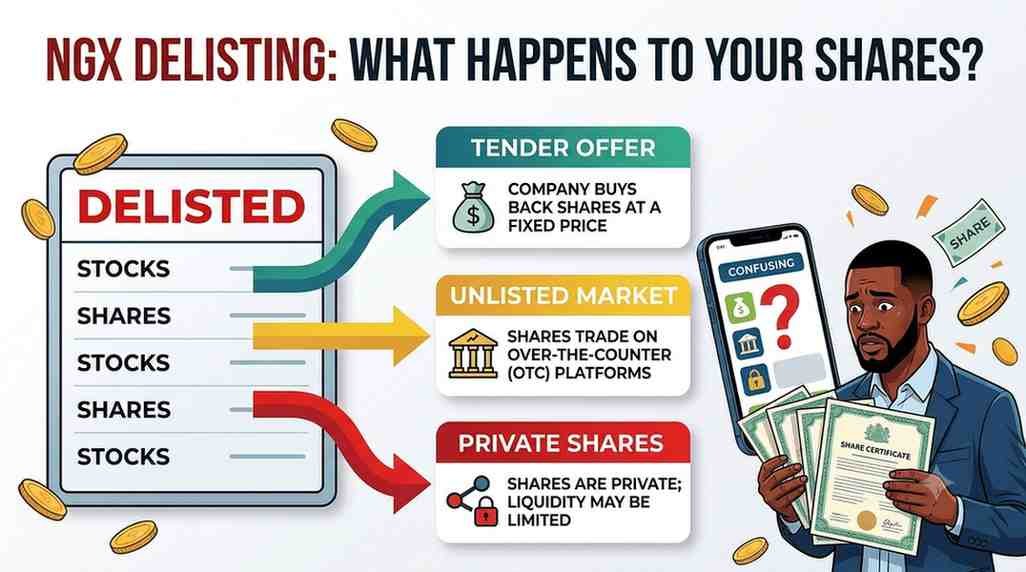
The short answer is that delisting does not erase your ownership. Your shares still exist, and you still hold them. What changes is where and how those shares can be traded. This guide explains how NGX delisting works, what separates a voluntary exit from a regulatory one, how to tell whether a company's delisting is actually finished or still in progress, and what practical steps are available to shareholders once a company leaves the Exchange.
What Does It Mean When a Company Delists from the NGX?
Delisting means a company's shares are removed from the Nigerian Exchange's Daily Official List and can no longer be bought or sold through the Exchange's regular trading system. It does not mean the company stops existing, and it does not automatically mean the company is in financial trouble, though that is sometimes the case.
Delistings on the NGX generally fall into two categories, and the category matters for what happens next.
Voluntary Delisting
Voluntary delisting happens when a company itself applies to leave the Exchange, usually to reduce compliance costs, simplify decision-making, or complete a restructuring. Shareholders typically vote on the decision at an Extraordinary General Meeting before it proceeds.
A well-known example is 11 Plc, formerly Mobil Oil Nigeria, which voluntarily delisted in 2021 after 42 years on the Exchange, citing greater operational flexibility and a lighter regulatory burden. The company continued operating as an unlisted public company afterward.
Involuntary (Regulatory) Delisting
Involuntary delisting is imposed by NGX Regulation when a company repeatedly fails to meet listing requirements, such as filing audited financial statements on time, maintaining minimum free float, or meeting corporate governance standards. According to BusinessDay's reporting on NGX delisting activity, this is treated as the ultimate sanction the Exchange can apply to a persistently non-compliant issuer.
Free float requirements are one common trigger. Companies whose publicly traded shares fall below the required threshold are typically given a grace period, often around six months, to correct the shortfall before facing suspension and, eventually, delisting.
How Common Is Delisting on the NGX?
Delisting is not a rare, one-off event. Since 2002, roughly 119 companies have left the Nigerian Exchange, and the reasons split fairly consistently across a few broad categories.
According to an analysis of NGX data by Dataphyte, about 65.6% of these delistings were regulatory or forced removals, roughly 20.2% were voluntary decisions by the companies themselves, and the remainder were tied to mergers, acquisitions, or a shift from private to state ownership. Between 2021 and 2023 alone, around 15 companies delisted from the NGX, and a further 14 had delisting proceedings approved against them in 2024, according to THISDAY's reporting.
This history is worth keeping in mind if you're facing a delisting notice for the first time. It's a routine part of how the Exchange enforces its rules, not an unusual event reserved for companies already in crisis.
Do You Still Own Your Shares After a Delisting?
Yes. Delisting removes a company from the Exchange's trading platform, but it does not cancel your shareholding or your legal ownership of the company. What changes is your ability to trade those shares through the NGX.
When the Company Is Still Operating
If the company continues operating and has not entered liquidation, your shares remain a valid ownership stake, they simply cannot be traded on the NGX anymore. This was the case for shareholders of DN Tyre & Rubber Plc after its April 2026 delisting, according to legal analysis of the case, which confirmed shareholders retained legal title despite the trading halt.
When the Company Enters Liquidation
If the company is being wound up, the outcome for ordinary shareholders is different. Creditors and preference shareholders are typically repaid first, and ordinary shareholders receive whatever remains, which can be significantly reduced or, in some cases, nothing at all. This is a separate process from delisting itself, though the two sometimes occur together.
Voluntary vs. Involuntary Delisting Compared
| Factor | Voluntary Delisting | Involuntary Delisting |
|---|---|---|
| Who initiates it | The company, with shareholder approval at an EGM | NGX Regulation, due to non-compliance |
| Common triggers | Cost reduction, restructuring, reduced disclosure needs | Late filings, low free float, governance breaches |
| Typical shareholder outcome | Payout window for exiting shareholders, or migration to NASD OTC | Shares remain valid but untradeable on NGX; OTC migration if arranged |
| Example | 11 Plc (2021), MRS Oil Nigeria Plc (2025) | DN Tyre & Rubber Plc, Greif Nigeria Plc (April 2026) |
How the NGX Delisting Watchlist Works
NGX Regulation periodically publishes an X-Compliance Report that flags companies at risk of delisting under two categories: Delisting Watchlist (DWL) and Delisting In Process (DIP). Reviewing this report is one of the more useful due diligence habits for anyone holding, or considering buying, small or thinly traded NGX stocks.
What DWL and DIP Status Mean
A company placed on the Delisting Watchlist has been flagged for a compliance shortfall, such as a free float breach, and is typically given a defined grace period to correct it. A company that moves into Delisting In Process has progressed further along that path, with delisting close to being finalized.
Companies Named in Recent Watchlist Reports
According to NGX Regulation's X-Compliance Report, as reported by African Markets on March 4, 2026, Union Dicon Salt Plc, Deap Capital Management & Trust Plc, Multi-Trex Integrated Foods Plc, STACO Insurance Plc, and Fortis Global Insurance Plc were named on the Delisting Watchlist, while Greif Nigeria Plc, DN Tyre & Rubber Plc, and Ekocorp Plc had progressed to the Delisting In Process stage after more than two years under regulatory monitoring.
Because this list changes with each new X-Compliance Report, it is worth checking NGX's most recent report directly rather than relying on any single date-stamped summary, including this one.
"Delisting Process Started" Doesn't Always Mean "Already Delisted"
No. A company can be publicly reported as marked for delisting, or have its board approve delisting proceedings, years before its shares are actually removed from the NGX's Daily Official List. In some cases the process stalls or is extended rather than completed on schedule, which is easy to miss if you only see the initial headline.
STACO Insurance Plc is a documented example of this gap. NGX RegCo approved the start of delisting proceedings against STACO in 2024, alongside 13 other companies, according to THISDAY's reporting at the time. Yet a regulatory committee decision on February 14, 2025, placed STACO on an extended three-year monitoring period instead of finalizing its removal, according to Nairametrics' March 2026 update. The company's shares were still actively trading on the NGX as of mid-2026, according to financial news coverage from that period.
The practical lesson: a headline saying a company has been "marked for delisting" is not confirmation that its shares have already left the Exchange. Before assuming your shares have become untradeable, check the company's current status in NGX's latest X-Compliance Report or ask your stockbroker directly.
Confirmed NGX Delistings, 2021 to 2026: Quick Reference
The table below compiles confirmed, completed delistings from the NGX across the past five years, drawn from NGX disclosures and Nigerian financial media reporting published separately over time. It is not exhaustive, since delistings occur on an ongoing basis, but it offers a single reference point for the most notable recent cases.
| Company | Date | Type | Reason / Outcome |
|---|---|---|---|
| 11 Plc (formerly Mobil Oil Nigeria) | 2021 | Voluntary | Migrated to NASD OTC after 42 years listed |
| Portland Paints and Products Nigeria | 2021 | Merger | Merged into Chemical and Allied Products (CAP) Plc |
| Ardova Plc | July 2023 | Merger / Buyout | Majority shareholder bought out minority shareholders |
| RAK Unity Petroleum | October 2023 | Liquidation | Completed liquidation after more than 40 years listed |
| GSK Consumer Nigeria | February 2024 | Voluntary | Parent company restructured its Africa operations |
| Goldlink Insurance Plc | 2024 | Involuntary | Non-compliance with post-listing requirements |
| Medview Airline Plc | 2024 | Involuntary | Non-compliance, years of inactive trading |
| Capital Oil Plc | April 3, 2025 | Involuntary | Non-compliance with disclosure and governance rules |
| MRS Oil Nigeria Plc | July 28, 2025 | Voluntary | Migrated to NASD OTC after shareholder-approved payout window |
| Greif Nigeria Plc | April 9, 2026 | Involuntary | Non-rendition of audited financial statements |
| DN Tyre & Rubber Plc | April 9, 2026 | Involuntary | Non-rendition of audited financial statements |
Compiled from reporting by Nairametrics, THISDAY, African Markets, and legal analysis of the 2026 cases.
Real Example: What Happened to MRS Oil Nigeria Shareholders
MRS Oil Nigeria Plc's 2024 to 2025 voluntary delisting shows how a structured shareholder exit can work in practice. Shareholders approved the move at an Extraordinary General Meeting on June 25, 2024, as part of the company's transition to the NASD OTC Securities Exchange.
According to reporting on the transition, MRS Oil arranged a payout window for dissenting and absentee shareholders who wished to exit, running from April 4 to July 4, 2025. Shareholders who did not take the payout were migrated to the NASD OTC platform once the window closed. The delisting from NGX's Daily Official List took effect on July 28, 2025, and the company's registrars continued to maintain shareholder accounts for a further period to manage the transition.
What You Can Do If Your Shares Get Delisted
If a company you hold shares in is delisted, a few practical checks are worth making rather than assuming the investment is a total loss.
- Check for a payout window. Some voluntary delistings set aside funds to buy out dissenting or absentee shareholders within a defined window, as MRS Oil Nigeria did between April and July 2025.
- Understand NASD OTC trading. Many delisted companies migrate to the NASD OTC Securities Exchange, a separate market where shares can still be bought and sold, typically with wider bid-ask spreads and fewer active participants than the NGX.
- Contact your stockbroker or the company's registrar. Your CSCS account and registrar records determine how any payout or share migration reaches you, so confirming your details are current is a useful first step.
- Confirm the company's actual status, not just the headline. A "marked for delisting" report is not the same as final removal, sometimes the process takes years or gets extended, so check NGX's latest X-Compliance Report before assuming your shares are untradeable.
- Review free float and compliance history before buying thinly traded stocks. Checking a company's standing on NGX's X-Compliance Report before investing can help flag delisting risk early, particularly for small-cap or infrequently traded names.
A licensed stockbroker or portfolio manager can help you evaluate what a specific delisting means for your holdings. Browse licensed stock market investment providers or portfolio management services on Insights.ng if you're weighing this alongside a broader strategy.
Frequently Asked Questions
What happens to my shares if a company delists from the NGX?
You keep legal ownership. The shares simply can no longer be traded through NGX's regular market. Depending on the company's arrangements, they may migrate to the NASD OTC Securities Exchange or be covered by a payout window for exiting shareholders.
Can I still sell my shares after a company is delisted?
Usually, yes, if the company arranges migration to the NASD OTC Securities Exchange, though trading there tends to be less frequent and less liquid than on the NGX. If no alternative market is arranged, selling can become difficult.
What is the difference between voluntary and involuntary delisting?
Voluntary delisting is the company's own decision, put to shareholders for approval, often to cut listing costs or simplify a restructuring. Involuntary delisting is imposed by NGX Regulation after repeated non-compliance, such as late audited financials or a free float shortfall.
What is NASD OTC and how does it work?
It's a separate, over-the-counter trading platform in Nigeria for shares of companies not listed on the NGX. Buying and selling continues there, but under different rules, with typically lower volumes and less regulatory oversight.
How do I check if a company is on the NGX delisting watchlist?
NGX Regulation periodically publishes an X-Compliance Report naming companies on the Delisting Watchlist (DWL) or in Delisting In Process (DIP). Checking the latest report before buying a thinly traded or small-cap stock can help you spot delisting risk early.
If NGX has approved a company's delisting, does that mean it's already delisted?
Not necessarily. NGX approving the start of delisting proceedings is an early step, and the process can stretch over months or years, sometimes with extended monitoring periods rather than final removal. Check the company's current status in NGX's latest X-Compliance Report or with your stockbroker rather than assuming a "marked for delisting" headline means your shares are already untradeable.
Key Takeaways
Seeing a delisting notice for a company you hold shares in can be unsettling, especially if it arrives without warning. But delisting on its own does not mean your investment has disappeared. It changes where your shares can be traded, not whether you still own them, and the process is sometimes slower or less final than the first headline suggests.
The more useful habit is checking a company's compliance standing before you buy, particularly for small or thinly traded stocks that are more likely to appear on NGX's watchlist. Reviewing free float, filing history, and recent X-Compliance Reports takes a few minutes and can help you avoid surprises later.
If you're building or reviewing a portfolio of Nigerian equities, consider working with a licensed stockbroker or wealth management provider on Insights.ng who can help you weigh this kind of regulatory risk alongside your broader wealth preservation strategy.
This article is for general educational purposes only and does not constitute financial, legal, or investment advice. Delisting outcomes vary by company and circumstance, and regulatory status can change between report cycles. Consult a licensed stockbroker, registrar, or financial advisor before making investment decisions, and verify current details directly with NGX, NASD, or SEC Nigeria.
Written by Irabor Osamudiamen
Published on August 8, 2026 ·
Comments (0)